What Does Standard Stock and Custom Production Mean?
The difference between stock metal composite materials and custom MCM production can depend on multiple factors such as color, size, and material core.
ALPOLIC, a global leader in metal composite material (MCM) manufacturing, takes pride in having the widest selection of stock materials. Our stock list features hundreds of materials of various sizes, thicknesses, cores, and colors. Not all stocked colors are standard in all these attributes, however. The distinction between standard stock inventory and custom production can be a challenge for customers, and our sales managers help navigate inventory and, if needed, assist with custom run production.
ALPOLIC’s expansive Corporate Identity (CID) program list often drives what is considered stock. Working with some of the biggest brands in the world, our National CID Sales Manager helps streamline their design process so every store, dealership, restaurant, or hotel can have the same recognizable look while maximizing panel yield in design.
Not every stock color is associated with CID. Ultimately, it’s important to define what makes up MCM to recognize what variables exist.
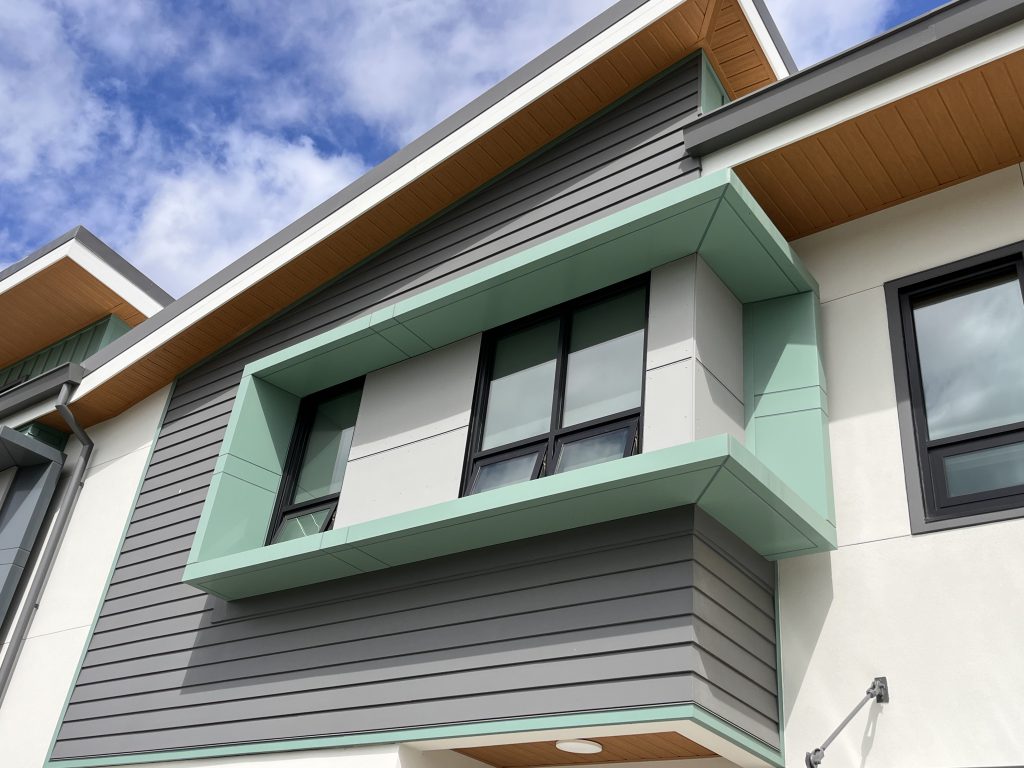
Mountain View High School, featuring a custom green MCM
Paint Type
Understanding finish types is imperative to understanding the finished product. In architectural applications, fluoropolymer paint systems are the most common and most recommended. These include a 100% FEVE resin (brand name Lumiflon) and a 70% PVDF dispersion (brand name Kynar). Both meet AAMA 2605, the highest standard for architectural coatings.
There is also the family of polyester paints, including high-performance polyester, siliconized polyester, super polyester, and others. These paints are more susceptible to UV degradation.
See Related Article |
|
|---|---|
 |
Polyester Versus Fluoropolymer Paint in Interior or Exterior Applications
|
Color
ALPOLIC MCM provides a seemingly infinite palette of colors. A wide variety of paints even have additives such as mica flakes or pigments to make dynamic visuals like sparkling shimmers or color-changing prismatics. The crisp lines needed for multi-color panels are made possible with ALPOLIC’s state-of-the-art die coating process.
Thanks to ALPOLIC’s image transfer process, the Pattern Series offers the natural look of wood, stone, or rusted steel without the same maintenance, installation, or cost concerns.
Gloss
From understated to standout, ALPOLIC has the widest gloss range in the industry. Gloss can even be a factor in color perception. While the Matte Series can produce gloss levels as low as 6, typically, finishes fall into low (30 gloss), medium (50 gloss), to high (70 gloss).
Skin Material
MCM is the broad category for metal composite materials. The most typical is painted ACM or aluminum composite material, but MCM also includes natural metals such as copper, zinc, stainless steel, and titanium. And there is also a class of anodized aluminum that provides a deeply lustrous look in a tough as nails finish.
Skin Thickness
The typical skin thickness of ACM in architectural applications is 0.020”. A thinner 0.012” skin can be used in applications such as signage and canopies. There is also a special panel that is 0.005” thick, predominantly used for flat, interior applications. For the toughest applications, ALPOLIC/HD is available with a skin thickness of 0.032”.
Core Material
There are three main types of core material: PE (polyethylene), FR (fire-resistant), and NC-US (non-combustible). ALPOLIC™/NC-US, the first non-combustible MCM for the U.S. market, and ALPOLIC/fr are recommended for use on projects above 40 feet in height. Within the polyethylene core category, there is the common solid core and the specialty foamed core used with the .005 skin.
Sheet Widths
The common aluminum coil widths are 40, 48, 50, 51, 60, and 62 inches. Natural metal skins may have different widths.
Sheet Lengths
The potential lengths available from ALPOLIC can run sheets from 72” minimum to a maximum of 288”, though the common lengths are 122”, 146”, and 196”.

So what is standard stock inventory?
ALPOLIC has pages and pages of stock inventory that are updated regularly, so customers can navigate tight lead times. However, we carry our stock finishes in a limited combination of attributes, including size, core and color.
Custom Production Explained.
Sometimes customers need a new custom color formulation. But with hundreds of options to choose from, they can often find a look that meets their needs from ALPOLIC's stock list options. However, if a variable such as gloss, core, skin thickness, or size changes from what is on the Standard Stock Inventory list then the new item is considered custom. Custom MCM at ALPOLIC requires a 1,000 square feet minimum production run.
For example, BNT Bone White is stocked in several widths, lengths, and cores. 4mm x 50 x 146, 4mm x 50 x 196, 4mm x 62 x 146 and 4mm x 62 x 196, in PE core are standard. In FR, 4mm x 50 x 196, 4mm x 62 x 196 are standard. In NC-US, BNT is available in 4mm and 62” wide. All combinations are in a 30 gloss, fluoropolymer paint system.
See Related Article |
|
|---|---|
 |
ALPOLIC and Sherwin-Williams: Achieving Custom Color Excellence
|
Any difference in the combination of attributes from what is standard stock inventory, such as a request for 3mm, is considered a custom production run.
Another example would be TBL black. It is standard in 3mm x 51 x 122 and 4mm x 62 x 196, both in PE core and 70 gloss fluoropolymer paint. If other widths, or FR or NC-US or polyester paint is required, this request is custom.
Ultimately, the fact that a color is on the Standard Stock Inventory list does not mean it is stocked in all sizes or thicknesses or cores. Changes to standard result in custom production, but it doesn’t always mean it will cost more. A large enough purchase order can still capitalize on standard stock pricing.
ALPOLIC is known for quality products and exceptional service and support. Your ALPOLIC Sales Manager or Customer Service representative will be happy to assist your specific project requirements and help determine cost so your project can stay on budget.
Editor’s Note: This article, originally published on June 3, 2022, has been updated to include references to ALPOLICTM/NC-US, the first non-combustible metal composite material available in the United States. This groundbreaking advancement in fire-safety expands what’s possible in building façade material. Contact your regional sales representative to learn more.
 ALPOLIC Color Matters Brochure